Aswat Ensemble

ASWAT
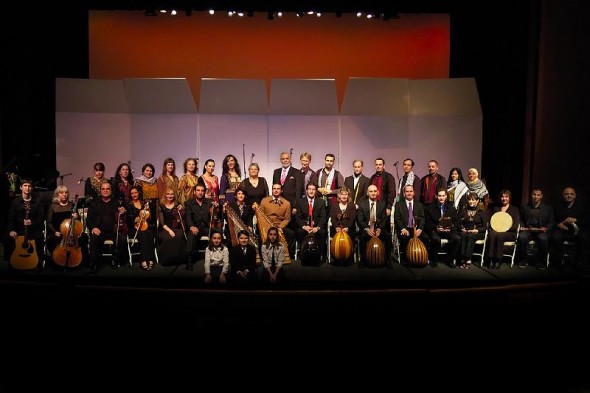
ASWAT Ensemble was founded in the Bay Area in January 2000. Founder Nabila Mango, a Palestinian American cultural activist, has been selflessly dedicated to ASWAT since its inception and, through years of hard work and tireless dedication, has brought together a family of musical ambassadors supportive of her deep love of Arabic music.
In just eight years, ASWAT has transformed itself from an informal community choir to a professional performing group selling out concerts at each of its biannual performances. Born simply from the desire to sing, ASWAT has become an anchor in the Bay Area Arab American musical scene.
The very act of singing itself preserves musical legacies dating back thousands of years, and celebrates songs that express the essential soul of Arab culture. ASWAT’s growth is itself an accomplishment, taking place in the shadow of hate crimes and mounting hostilities aimed at Arabs and Muslims following the 911 tragedy.
ASWAT has enabled musicians to learn and expand their knowl edge of Arabic classical and folk music. It is a forum in which both Arab and American musicians alike form bonds with each other through a shared experience. For the Arab-American ASWAT members, the group is an affirmative collective where they can experience their culture as a living thing that not only brings them pride but serves as a conduit for inviting others to appreciate their often maligned and misunderstood heritage.
ASWAT welcomes anyone who is interested or even curious about Arabic music to learn more by contacting ASWAT at: join@zawaya.org or nabila@zawaya.org.
Rachid Halihal:
Music Director
Nabila Mango:
Founder & Administrative Director
Jose-Antonio Nasser: Internet Administrator
Danny Fryer and Nabila Mango: Arabic Language Teachers

Aswat Ensemble
INSTRUMENTALISTS
Rima Ayyesh (Violin)
Kate Bancroft (Percussion)
Kristina BenArab (‘Oud)
Hector Bezanis (Nay, Mijwiz)
Yates Brown (Electric Guitar)
Loren Chase (‘Oud)
Loay Dahbour (Percussion)
Younes El-Makboul (Violin)
Mina Girgis (Violin)
Amina Goodyear (Percussion)
Gregory Hamburg (‘Oud)
Sandy Hollister (Percussion)
Peter Holmes (Percussion)
Bashar Kellow (‘Oud)
Sarah Michael (Qanun)
Sara Salzmann Mohan (Violin)
Guilnard Moufarrej (Qanun)
Morgan Nilsen (Clarinet)
Husain Resan (Violin)
Lean Sirkin (Violin)
Murat Turke (Percussion)
VOCALISTS
Samia Abou Samra
Zahra Akifi
Samira Boudjenana
Wael Buhaissy
Mounia Chermal
Yasmeen Daifallah
Lina Del Roble
Nadia Fattah
Danny Fryer
Nicole Hammer
Alex Hughes
Fatma Goze
Khadija Guetar
Imad Jabbour
Nadine Jahchan
Ayman Kozman
Johnny Kuborssy
Houda Lahlou
Rana Mroue
Jose-Antonio Nasser
Khaled Nikro
Dilek Seren
Noam Smooha
Christine Stouffer
Gunsu Temirer
About the Music and the Instruments
Aswat Ensemble performs classical and folk songs from various Arab countries. The ensemble plays traditional musical instruments such as the qanun (trapezoidal zither), ‘ud (lute), nay (reed flute), Kaman (violin), riqq/daff (tambourine), tar and darbukkah/tablah (goblet drum). The program features a number of songs using different maqamat (modes). The performance includes muwashsha hat, and songs of major artists in Egypt and Lebanon of the 19th and 20th centuries such as Fairuz, Abdel Halim Hafiz, Abdel Wahab, Um Kulthum. The ensemble also performs folk songs from Syria, Palestine, Jordan, Iraq, and the Arabian Gulf.
GLOSSARY
Debke – linedancing in Jordan, Lebanon, Palestine and Syria.
Darbukkah – goblet shape hand drum
Maqam (maqamat) – mode; an Arab system of pitch or ganization that allows for the construction of melodies and improvisation (taqseem) within a scale.
Muwashshah – a “postclassical” singing form not rigidly governed by the qasidah, originated in the Middle East, and integrated into the music of AlAndalus in the 10th Century
Qad Halabi – a folkloric song based on the melody of an other regional folk song, especially Turkish or unknown older Arabic songs.
Qadim – old (unknown composer)
Qasidah – a poem set to music consisting of 1025 or more lines of poetry Riqq – fish skin tambourine Taqsim – nonmetric improvisation played in a maqam
‘Ud – Arabic style fretless lute